Developing the Future of Edge AI
The AutoEcology Vision
At AutoEcology, we’ve spent the last few years researching the intersection of computer vision, artificial intelligence, and ecological monitoring. Using our expertise in edge compute and AI systems, we have been working to bring together the most effective methods for real-time species identification. Importantly, we aim to do so in a way that is genuinely practical for real-world field deployment.
As discussed in previous articles, traditional approaches to automated species monitoring typically involve collecting large volumes of video or image data in the field and transporting it to a cloud system or computer for analysis after the fact. At AutoEcology, we prefer a different approach, rather than treating AI object detection as a post-processing step, we embed it directly into the sensing hardware itself.
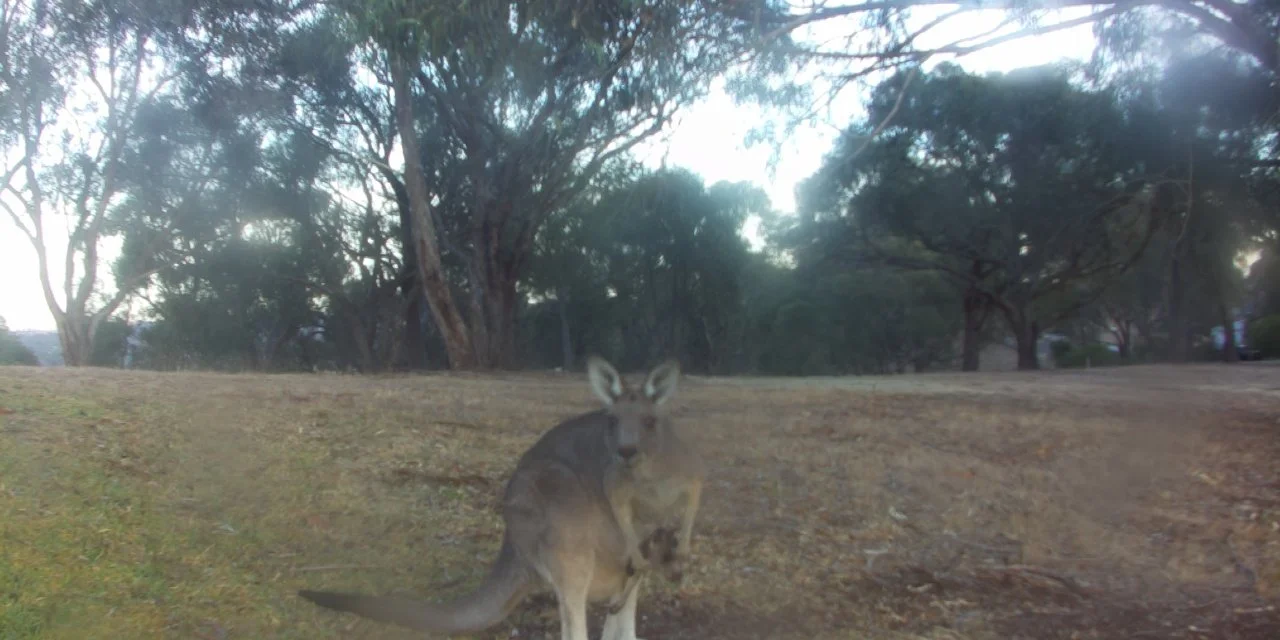
An interested Roo
We believe this shift brings many important advantages. Because image processing happens in real time at the point of capture, there is no need to move large volumes of data just to get your results. Insights are available immediately, and the devices can even react to detections as they happen. This reaction could take the form of triggering external systems or sending alerts in the moment.
This real-time, on-device processing also improves performance. Running inference continuously on captured footage, rather than on batched exports, can result in fewer false positives and higher overall detection accuracy.
The result is a fundamentally different kind of monitoring system, one that is simpler to set up and deploy, more responsive to events in the field, and well suited to long-term unattended operation in remote locations.
Our Technology
As an outcome of our R&D work AutoEcology has developed two field-ready monitoring devices, each solar powered and designed for year-round deployment in remote locations. Both are capable of locally logging video, images, and raw detection data, as well as transmitting results over 4G to cloud databases. Both can also trigger external devices via hardwired connections or wirelessly via LoRa, Bluetooth, or Wi-Fi, enabling straightforward integration with existing systems.
Both devices run custom software capable of executing custom-trained object detection models tailored to the target species or application. Detections are tracked in real-time, further improving accuracy and reliability. The software is configurable to suit a wide range of monitoring scenarios and data output requirements.
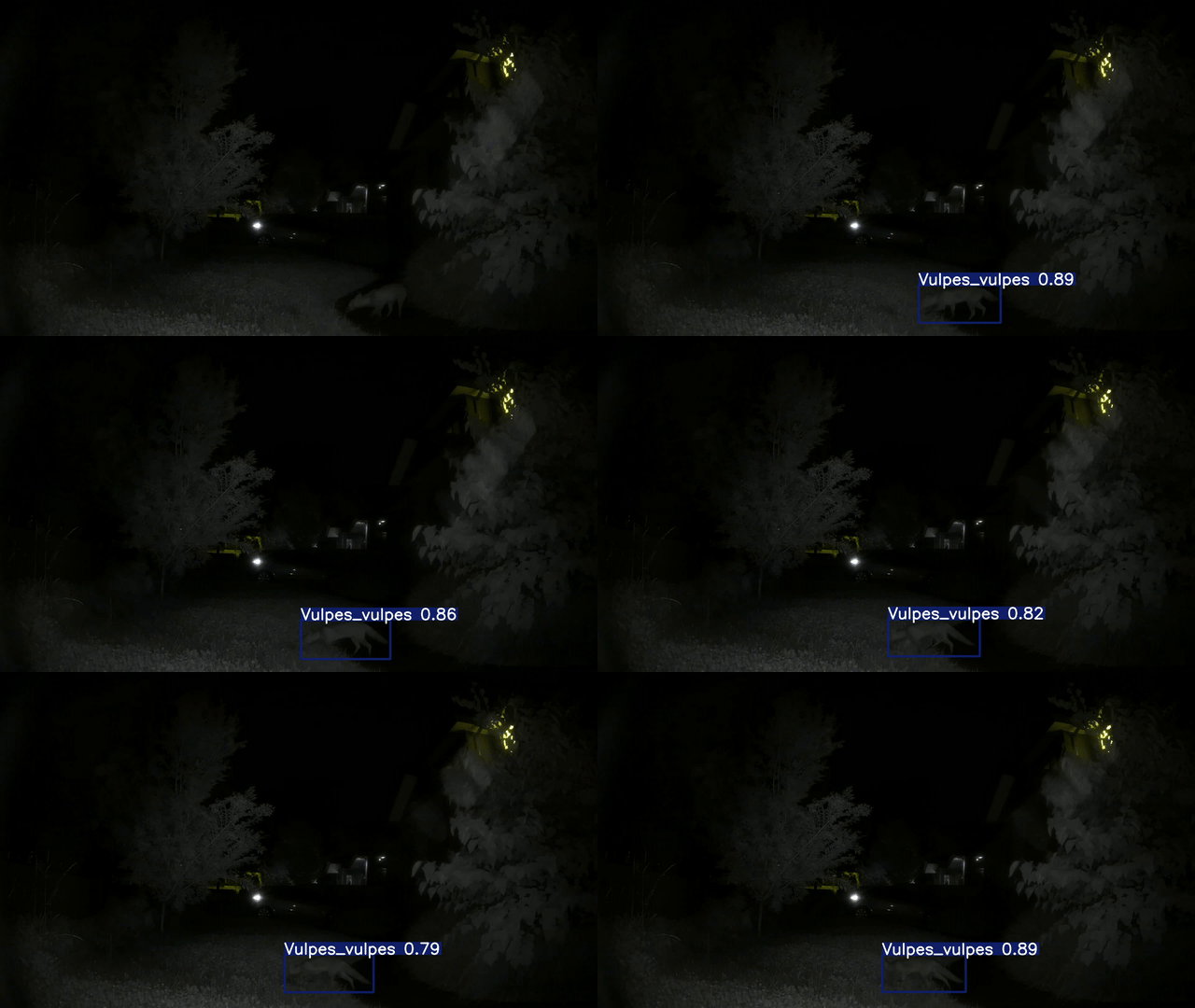
Detecting and tracking a Fox in real-time
The Day-Time Monitor
Our Day-Time Monitor is designed for daytime or scheduled partial-day operation. Because it operates only during daylight hours, its power requirements are modest, and the entire device, including the battery, can be housed in a single compact custom enclosure. The built-in battery can provide several days of independent operation, depending on the application. When combined with an external 60–100 W solar panel, the device can run indefinitely without any manual intervention.
The default Day-Time Monitor features an autofocus camera capable of capturing and processing 4K video, significantly extending the effective detection range compared to lower-resolution systems. Depending on the size of the target species, reliable detection is achievable at ranges of 20 metres or more.
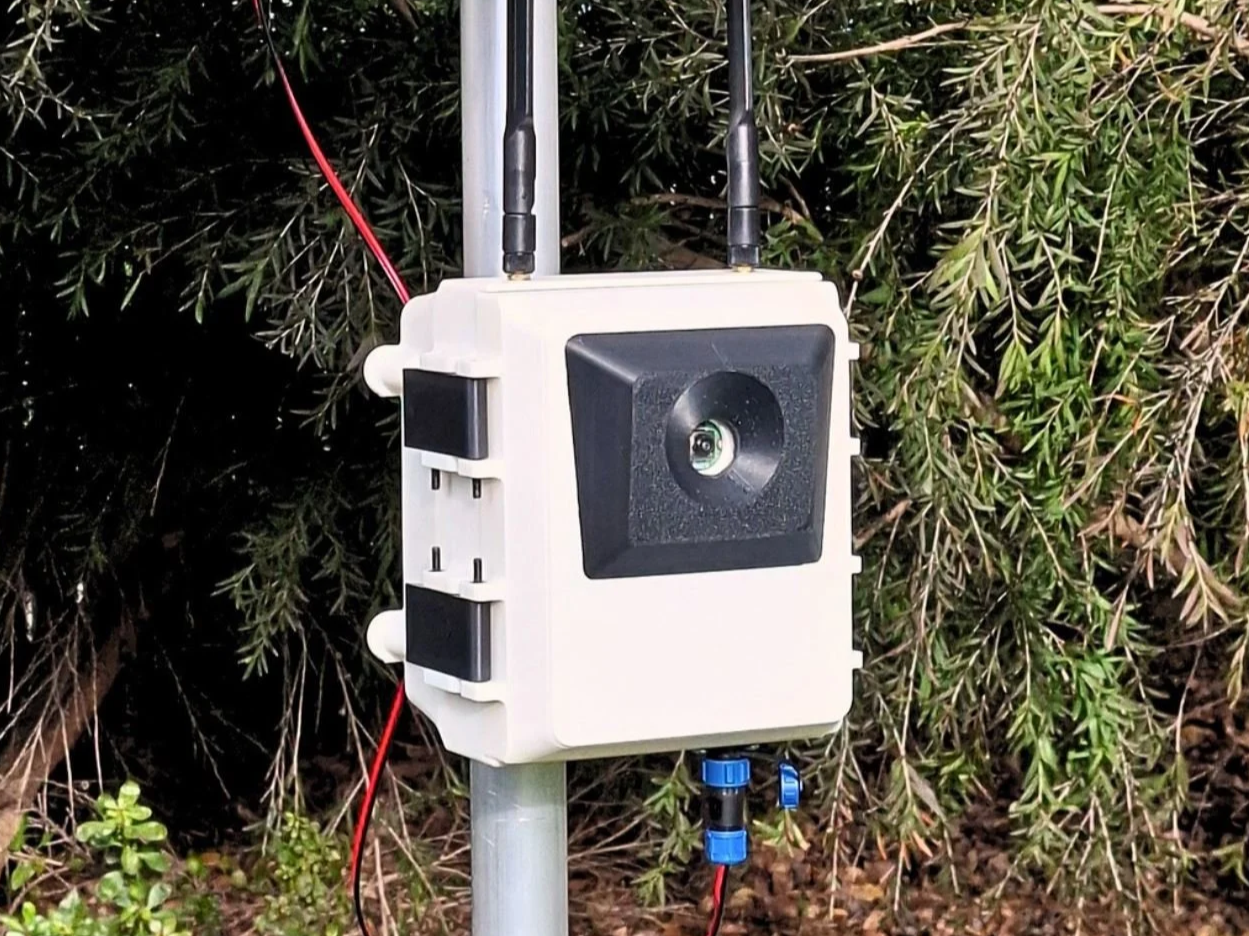
Day-Time Camera Box
The Day/Night Monitor
The Day/Night Monitor is built for continuous 24/7 operation. It features a Sony Starvis camera with an automatic infrared cut filter that switches between day and night modes, alongside built-in infrared LEDs that activate automatically in low-light conditions. This makes the device equally capable in complete darkness as in full daylight.
Power is supplied by a large external 12 V lithium iron phosphate (LiFePO₄) battery, available in a wide range of off-the-shelf capacities to suit the requirements of the deployment site. The device can run entirely on battery power for weeks at a time, or indefinitely when paired with a 120 W solar panel.
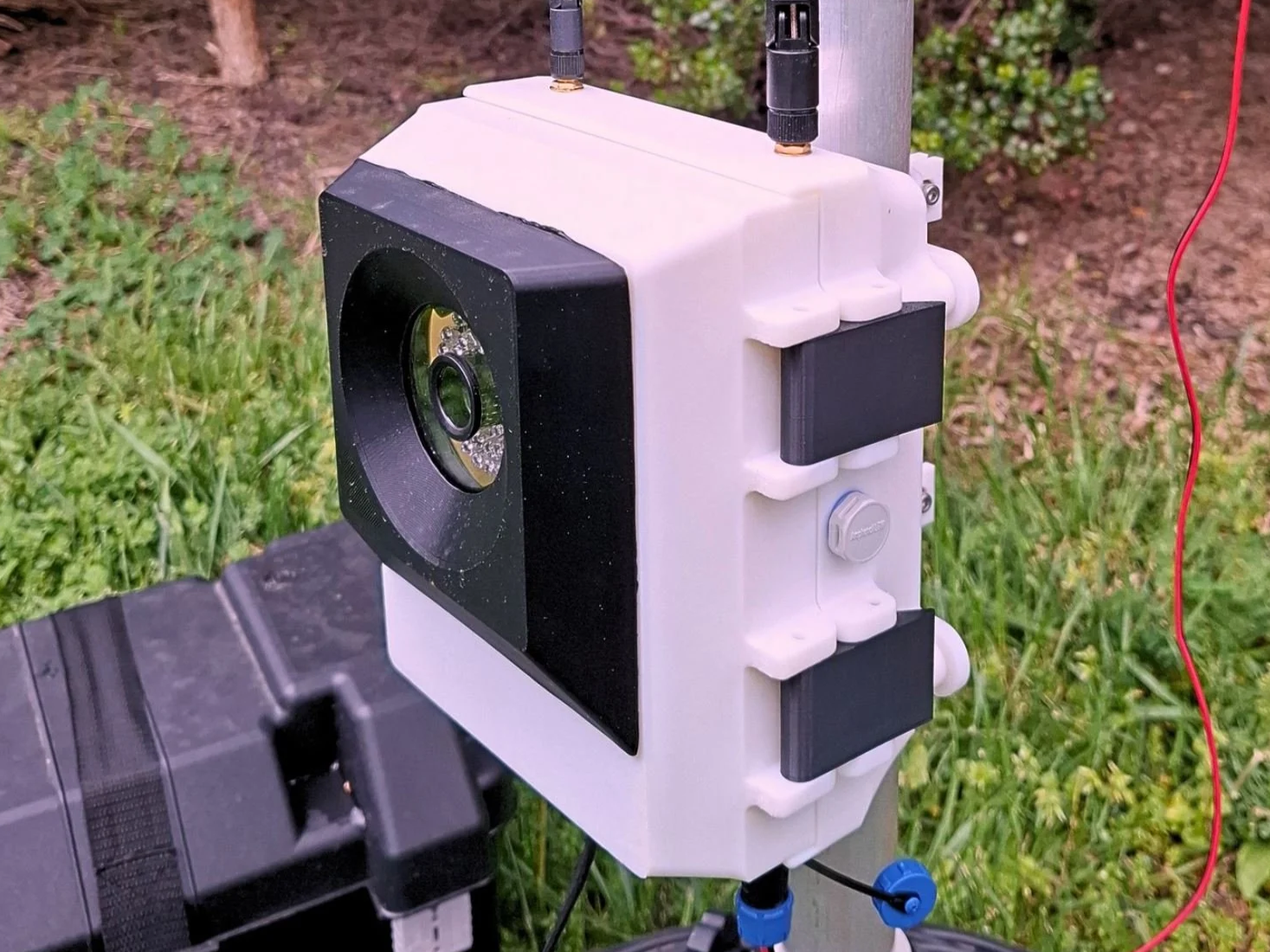
Day/Night Device
While these two configurations represent our default, field-tested setups, both devices can be customised to meet specific project requirements. Options include alternative camera types and lens arrangements, including thermal cameras. It is also possible to integrate other sensor types or third-party hardware.
Continued Development
AutoEcology is currently collaborating with a number of organisations to test and deploy these devices in real-world settings, integrating real-time species detection into both new and existing monitoring workflows.
In parallel, we are continuing to develop the next generation of integrated hardware and software packages. These will be products designed to make this technology easy to adopt, whether for companies building it into their own products, or for conservation groups and researchers using it directly in their fieldwork. These will offer a ready-to-use, off-the-shelf solution that brings real-time ecological monitoring within reach for a much wider range of users.
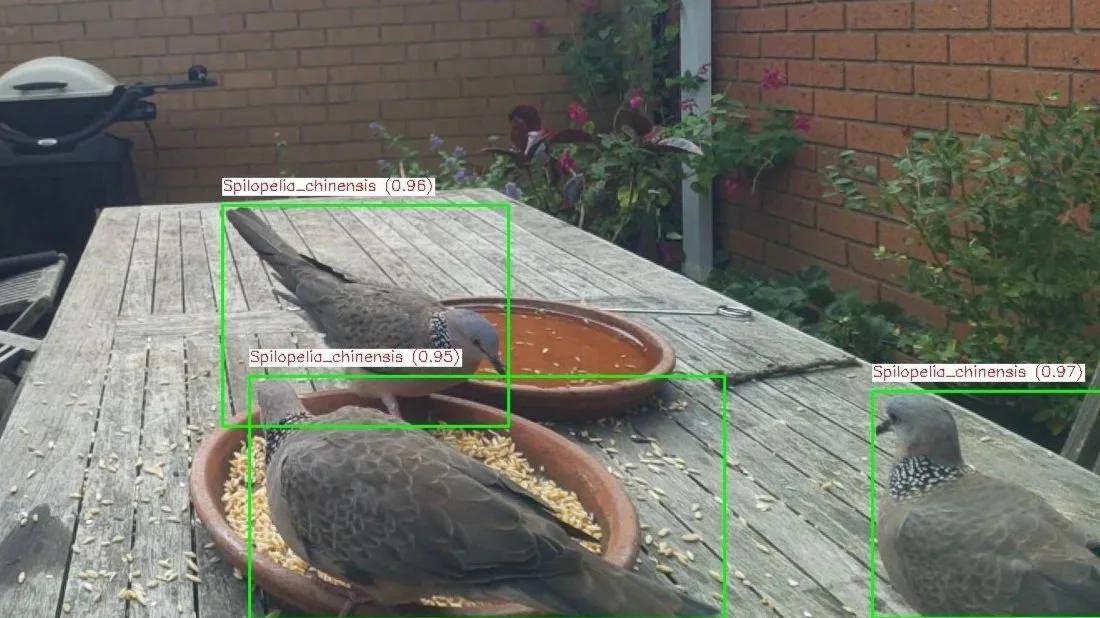
Detecting and Identifying Birds
An early step in this direction is our development of the PV Pi, a solar power management board for the Raspberry Pi. The PV Pi provides high-capacity solar battery charging and power management as well as other smart features, enabling edge compute hardware to be deployed in remote locations. It is the first of a growing ecosystem of integrated, mass-producible hardware and software products that AutoEcology is developing.
Get in Touch
If you are interested in learning more about our current devices, or would like to discuss how AutoEcology’s technology could support your work, we would love to hear from you.
